

The Acquisition:
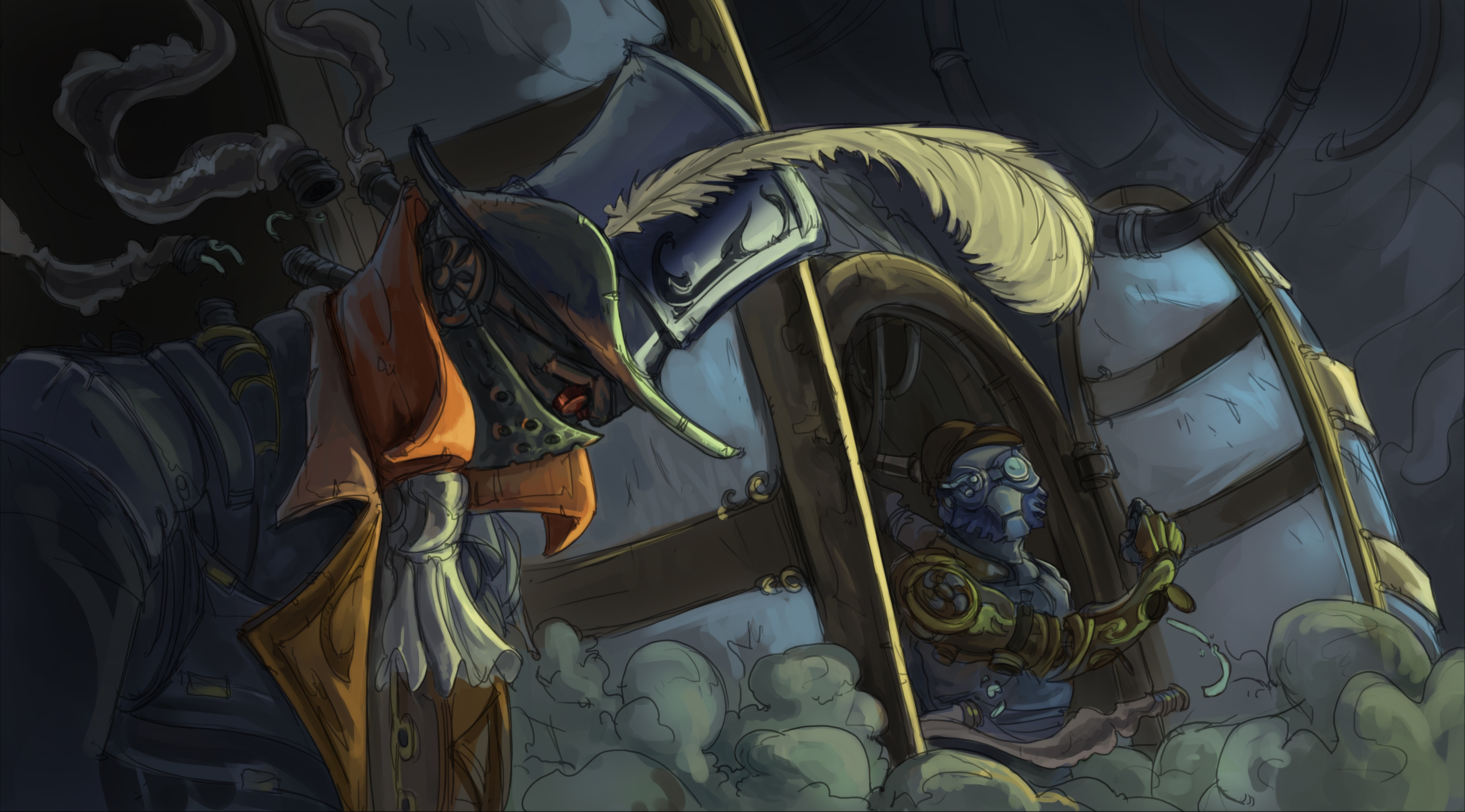
Carter tapped a finger on the table, annoyed. Mason was late. Carter disliked tardiness. Unlike money, time was currency that could not be re-earned. To him, the greatest gift one could bestow upon another person was the gift of seconds, minutes, hours of your very life. Lately, with all the developments surrounding nodes of The Engine, Carter felt he had less and less time to give. To have it wasted was an affront that he would address with Mason when the pigman finally showed his face. Worse still, he had to sit in a dingy, roach-infested pubhouse near the docks. The stench would stay in his nostrils for hours after. Mason, of course, had chosen the meeting place. While its location and discreet clientele would ensure their conversation would remain clandestine, it didn’t mean Carter had to like it.
Finally, the door opened, and the ample figure of the smartest of the Journeymen tromped into the tavern. He spotted Carter through his pince-nez, gave the man a smirk, and approached.
“You took your time,” Carter said in a clipped tone as the mercenary filled the seat across from him.
“Patience is a virtue,” replied Mason, still smirking. “There are innumerable fairy tales and parables on the subject. Perhaps you’ve read a few of them?”
Carter grimaced. Mason knew damn good and well how versed he was in literature of all kinds. The pig was trying to goad him into a verbal joust.
The archaeologist pinched the bridge of his nose and took a long breath. “I understand you were successful.”
Mason’s smirk turned into a grin. “Straight to business, then.” He leaned back, looking smug. “That we were.”
“And? Where is the book?”
Mason waggled a finger. “Tut tut, Mister Carter. We require the second half of our payment.”
“Yes, about that,” Carter said, bracing himself. “You caused quite a ruckus. Abberline and his bobbies are all over that warehouse. Your…pet,” Carter practically spat the word out, “went too far. I take it as a minor miracle that none of the warehouse staff survived to become witnesses. Still, it drew unwanted attention. As such, I feel the need to revisit the agreed-upon amount.”
Mason shook his head. “You merely stipulated that the item should be retrieved. You never specified the manner of its acquisition.”
Carter scowled. “That should have been inherent in the conversation.”
Mason frowned, casually removed his glasses, and began wiping them with a handkerchief. “Contracts,” he said slowly, “are all about details, Mister Carter. I have near-perfect recall of every verbal contract we undertake. It is both a gift and a curse. Shall I restate your exact words back to you?”
Carter leaned back and crossed his arms. The pigman wasn’t lying. Their discretion, ruthlessness, and determination had earned them a reputation as effective problem-solvers. If Mason thought unleashing that beast inside Sullivan’s warehouse was the best and most effective approach, it likely was. Carter knew this. And Mason knew that Carter knew this. Besides, if the book proved to be as useful as purported, and if his other plans fell into place, it wouldn’t matter what Abberline uncovered.
The archaeologist sighed, accepting defeat. “No, there’s no need. You shall be paid what we discussed.”
Carter turned to look at a man sitting in a booth behind and motioned to him. The man stood and approached them, a beat-up leather valise in hand. He deposited the valise in the booth and then moved to stand beside Carter.
Mason flipped it open and thumbed through the stacks of wrapped ten-pound notes. He closed it and reached into a large pocket on his leather coveralls. From it, he produced a package roughly the size of a cigar box wrapped in brown paper. He placed the package on the table and slid it across.
Carter snatched it up and quickly unwrapped the package, revealing a small box. He then opened the box and stared at its contents. He felt the corners of his mouth turn up ever so slightly.
“I trust,” said Mason, “that you are satisfied with the results.”
Without looking up, Carter ran a finger along the edge of the book’s cover as he said, “That I am.” He then looked up at Mason. “You didn’t open it, did you?”
“As I said, you paid for its acquisition, nothing more. What you do with it is your business, not mine.”
Carter let out a breath, satisfied. “Good, good. I thank you for your discretion and your expediency, even if it came at the expense of some attention from the law. However, I will take this interaction as a lesson and shall be more careful in how I make my requests in the future.”
Mason nodded. “A sound perspective. I take it then that you wish to retain our future services.”
Carter closed the box, re-wrapped it, and handed the package to his man. He fixed the pigman with a brighter expression than he’d had when he arrived. “Mason, I believe there is much we could accomplish together. Most assuredly, I will call upon you in the future. I see great opportunities in our future.”
Mason smiled again and, with a gleam in his eyes, said, “As do I, Mister Carter.”
~*~
The electric light buzzed faintly as it blinked to life over Mason’s workbench. The pigman settled into his custom-built chair. He set the valise to one side; he would verify the amount later. From the nearby bookshelf, he retrieved a thick volume and opened it to the first page. At the very top in his own handwriting was the title, “A Treatise on the Origins of The Engine by Herodotus as translated by Thomas Crowley.”
Mason re-read his own writing to make sure he had copied it correctly from memory. That blasted lock on the book Carter had commissioned them to retrieve had been tricky. Making it look unsullied had taken every bit of Mason’s not-inconsiderable skill with locks. What he had failed to tell Carter was that, in addition to his perfect recall of conversations, the pigman could perfectly recall everything he read. He put that ability to use here by rewriting the entire contents of the book into this leatherbound notebook.
The writings themselves were strange, like the ravings of madmen. However, Mason reasoned that when a man of Carter’s station and intellectual calibre takes a keen interest in something, it was likely worth his own attention. He smiled as he reached his last stopping point and was satisfied that he’d found no errors in his work. He was about to start writing again when he was interrupted.
“Hey, Mason,” came Stalker’s voice. “Did ya get the money?”
Mason sighed. “I did indeed, little brother.”
“Oh, goodie! When we gonna divvy it up?”
“When I say,” said Mason, trying to contain his irritation. “I take it you successfully retrieved our wayward wolf.”
Stalker chuckled. “Heh. What was left of ‘im, yeah.”
That caught Mason’s attention. “What was left–” he stopped himself and took a breath. “What, pray tell, happened this time?”
“Seems he argued with a train and lost.” Stalker chuckled again.
Mason rubbed his forehead. He let out a long breath and closed the notebook. Finishing it would have to wait.
The Queen’s Ledger:
The Albemarle Club for Distinguished Explorers smelled of pipe smoke, cognac, and too much leather. On the walls hung the painted visages of men who’d died in foreign sands, immortalized mid-charge or mid-toast.
Carter stood near the hearth, gloved hands clasped behind his back. He’d dressed impeccably, dark frock coat, cravat neatly pressed, belt and buttons polished to a mirror shine. He was studying a photo of a pair of hunters standing over a very large elephant-like creature, but clearly not an elephant. He was, as always, early, though his patience was already fraying.
Across from him, sunk deep in a grand leather armchair, sat Sir Winston Poogh, Commander of Her Majesty’s Guardians of the Hundred Acre Wood. The man looked a war-torn gentleman, moustache trimmed with military precision, chest gleaming with decorations, belly betraying too many second helpings of treacle pudding.
His Gentlefolk aide, Gruntles, stood behind him, holding a large open notebook, fountain pen scratching in the measured rhythm of a machine. The faint ticking from within the brass-and-porcelain creature blended with the club’s many clocks.
Poogh cleared his throat with the weight of a cannon.
“Doctor Carter, I thank you for your punctuality. A rare virtue, these days.”
Carter inclined his head. “I make a habit of respecting other people’s time.”
“Splendid,” Poogh boomed. “Then let us waste none of it. We have before us certain matters of, ah, imperial housekeeping.”
He produced a folder thick with ledgers and stamped correspondence. “Her Majesty’s Treasury has raised… minor concerns regarding the expenditure of crown funds during your Egyptian endeavors. Your expeditionary accounts appear—” he peered down his spectacles “—extravagantly imaginative.”
Carter’s expression did not flicker. “I was led to believe the funds were to be spent in pursuit of knowledge.”
“Indeed,” said Poogh, “though the Exchequer prefers that knowledge be acquired without bankrupting the Empire.”
Poogh flipped a page, moustache twitching.
“Five thousand pounds in alchemical glassware, two hundred in gunpowder, and a crate labelled—ah—‘component parts, divine in nature’? A curious inventory for an academic.”
Gruntles’ head tilted slightly. “That last entry, sir, was catalogued under miscellanea arcana,” he offered helpfully, his voice a genteel whir of gears.
“Quite so,” Poogh grunted. “Miscellanea. Always the refuge of a creative accountant.”
Carter’s jaw tightened. “You’ll find, Sir Winston, that much of that expenditure was covered not by Her Majesty’s Treasury, but by private patronage — Lord Cyrus De Havilland, to be precise.”
Poogh’s eyes flicked up. “Ah, yes.The De Havillands.” He let the name roll off his tongue like something rich and distasteful. “One never knows whether their coin is Crown gold or something older.”
“Older, perhaps,” Carter replied smoothly. “But quite legitimate. His lordship’s family has funded half of Britain’s archaeological endeavors in the past decade. You’ll find his son, Horace, accompanied me in Egypt for precisely that reason, an arrangement of oversight, not indulgence.”
“Mm.” Poogh leaned back, watching Carter over steepled fingers. “Curious, then, that Lord Cyrus’s oversight seems to have ended rather abruptly. There are whispers he’s… withdrawn his confidence in your enterprise.”
Carter’s smile didn’t move his eyes. “Lord Cyrus’s confidence ebbs and flows like the Nile, Sir Winston. He funds results, and results require freedom, not quarterly reports.”
Gruntles made a faint whirring sound that might have been a mechanical snort. Poogh ignored it, closing the ledger with a heavy thump.
“Well then,” he said, “perhaps I should summon Lord Cyrus himself to clarify ownership of your discoveries. If private money was involved, Her Majesty will wish to ensure the Crown’s interests are not compromised by… competing patrons.”
Carter’s voice cooled. “I assure you, Sir Winston, my loyalty lies with discovery, not bureaucracy.”
Poogh smiled thinly. “Discovery can be a treacherous mistress, Doctor. One moment she kisses your brow, the next she bites your hand. I suggest you keep a close eye on your accounts…and a closer eye on your allies.”
Carter smiled faintly. “If the Crown wishes to learn what it paid for, I can provide a demonstration.”
Poogh waved a hand. “Heavens, no! The last time a scholar demonstrated something in this club, we lost a billiards table and half a waiter. No, no — I require paperwork, not pyrotechnics.”
He leaned forward, chair groaning. “Your travel logs, Doctor. All of them. Dates, ports, expenditures, recoveries. Her Majesty’s Office of Expeditionary Oversight insists.”
“And if I decline?”
Poogh’s eyes narrowed to amber slits. “Decline? My dear fellow, one does not decline the Queen. One simply delays her pleasure…and invites questions of loyalty.”
Behind him, Gruntles coughed delicately. “We are also required, sir, to examine any objects recovered during said expedition which might pose… metaphysical risk.”
“Risk?” Carter asked lightly. “Do you take me for a conjurer?”
Poogh smiled, but it did not reach his eyes. “No, Doctor. But I take you for a man who has a habit of finding things that shouldn’t be found.”
Silence fell for a moment. The fire crackled and popped.
After a lengthy silence, Carter finally said, “I will have the documents sent to your office within the week.”
Poogh’s smile returned — broader, smugger. “Splendid. I shall await them with bated breath and sharpened quill.”
He rose with surprising grace for a man of his size, brushed down his jacket, adjusted his sash, and extended a gloved hand. “A word of advice, good Doctor: London is thick with ne’er-do-wells these days. Thieves, radicals, other sorts of… collectors. One never knows who might come calling when one possesses objects of national interest.”
Carter took his hand in a firm grip, responding in a low voice. “I’ll keep that in mind.”
Poogh’s smile sharpened. “See that you do. It would be a dreadful thing if something… untoward were to happen before our accountants could finish their sums.”
He turned smartly. “Come along, Gruntles. I find the air here positively colonial.”
“Yes, Sir Winston,” replied Gruntles, closing the ledger with a metallic snap.
Carter watched the two depart, their boots echoing loudly as they crossed the floor. He watched the door close, a thin curl of amusement on his lips. Only when he was alone did he truly allow himself the faintest hint of a smile.
“Ne’er-do-wells, indeed,” he murmured. “You’ve no idea.”
The Watchers in the Fog:
The evening fog rolled off the Thames like a slow-moving tide of ghosts. By the time Carter left the Albemarle Club, the streetlamps were little more than faint blurs of amber caught in a sea of grey. His driver was late — again — another irritation. So he walked.
His bootheels clicked against wet cobbles as he adjusted his gloves, his breath curling white in the chill. Behind him, the noise of the club was rising, a celebration of some aristocrat’s return, drowning the city’s heartbeat in ruckus. Somewhere a bell tolled ten.
Carter’s hand brushed the weight of the revolver beneath his coat. Poogh’s warning echoed back to him: “Ne’er-do-wells… collectors.” A threat wrapped in civility. And yet, Carter mused, there was always truth buried in bureaucratic venom.
He turned onto Bishopsgate. A shape detached from the fog behind him, tall, too deliberate in its pacing. Another moved on the opposite pavement, keeping rhythm.
Carter paused near a shuttered apothecary, his eyes flicking to the glass. In the warped reflection, the two silhouettes halted as he did. Both wore overcoats too heavy for the weather and bowlers that hid their eyes.
“Amateurs,” he muttered.
From the shadows above, a faint tick-tick-whirr broke the silence. Carter looked up just in time to glimpse something small and mechanical skimming the fog. It was a brass-winged insect, its optics flickering red. A Servant’s drone. The realization turned irritation to ice.
He ducked into an alley between a tea merchant and an old boarded-up tobacconist, his boots splashing as he ran through puddles. The watchers followed.
A whistle blew somewhere in the mist. Three short notes, answered by two. Coordination. Not street thieves, then. This was organized.
Carter reached the far end of the alley, found a wrought-iron gate, and slipped through. On the other side, he paused beneath a guttering lamp, pulling a small canister from his pocket, an alchemantic flare from the famed Dr. Disraeli. He twisted the top. Blue-grey smoke hissed out, coiling upward, concealing him completely.
When the first pursuer stepped through the gate, Carter made his move. The butt of his revolver struck home behind the man’s ear with a wet crack. The second figure lunged from the fog and charged fast, too fast. Carter fired once. The flash lit the alley like lightning. The figure fell and the cloak fell open revealing brass beneath torn cloth. This was a Gentlefolk spy. Its cogs ticked weakly in its chest.
“Servants,” Carter whispered. “Of course it’s the bloody Servants.”
He crouched and inspected the machine. Its optics still glowed faintly, Crimson irises dilating and contracting. Then, from within its throat, a distorted voice rasped through static:
“You… shouldn’t have opened it…”
The light died. Carter straightened and tightened his jaw. He wiped the revolver on his sleeve, holstered it, and stepped back into the fog. Somewhere behind him, church bells began to chime the quarter hour.
“Let them watch,” he said quietly. “Soon enough, they’ll have something worth seeing.”


An independent tabletop game studio creating immersive experiences set in the Victorian steampunk world of Twisted.
THE GAME
What is Twisted?
Getting Started
Gameplay Videos
Rules
THE WORLD
Dickensians
Guild of Harmony
Scions of the Sand
Servants of the Engine
THE MINIATURES
About our Miniatures
Painting Guide I
Painting Guide II
info@dementedgames.com
Chat with us